MARSAD / CONSOLIDATED CATALOG / #018
Agitated phone caller drifts into the traffic corridor
Awaiting your 3D scene approvalCounterfactual proposal: an adult argues on a handheld phone while pacing on the south sidewalk. Distracted gestures become an unintentional step into the road, followed by short pacing within ego's corridor. The call continues and the caller remains partly in the corridor at 40 s, so ego never resumes.
Original description: 前方有人在路边打电话激烈争吵,情绪激动,可能会有突然的、无意识的肢体动作或走位。
Loading the full animated scene…
Critical moments
What to verify
- Verify exactly one caller and one separately identified phone persist throughout all 941 samples.
- Verify phone attachment, world reference positions, ear placement, and right-hand contact agree without snapping during every stationary turn.
- Verify left-arm gestures do not detach the phone, intersect the torso, or imply an interaction with an absent person.
- Verify the caller's actual walking speeds remain within 0.6–1.7 m/s apart from acceleration and braking, and stationary turns do not create lateral jumps.
- Verify the initial caller footprint lies on the police map's south sidewalk and the authored intrusion lies on its road polygon.
- Verify the caller's final footprint still intersects the buffered ego corridor; ego_release_s must remain -1 and ego must not creep past.
- Require human approval of the complete unresolved hazard, source-background conflicts, and the proposed 4 s review view before image generation.
Review notes
Inspected the full event contact sheet and phone interaction close-ups. The caller paces in the roadway with the phone at the ear and remains a persistent obstruction. Front-camera visibility is partly blocked by a foreground vehicle; later image selection must account for that.
Check action, relative position, facing, posture and visibility. Approximate offsets are acceptable. Sampled visual checks do not prove every contact or continuous collision clearance.
Rendered inspection views
Event, approach and final views rendered from the exact committed Higgsfield Blender source. These are procedural 3D previews, not generated training photographs.
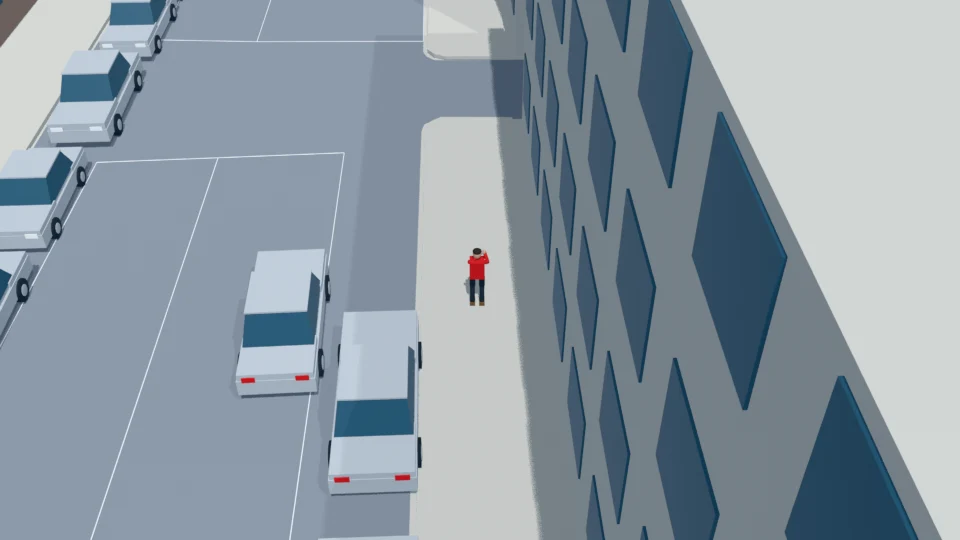
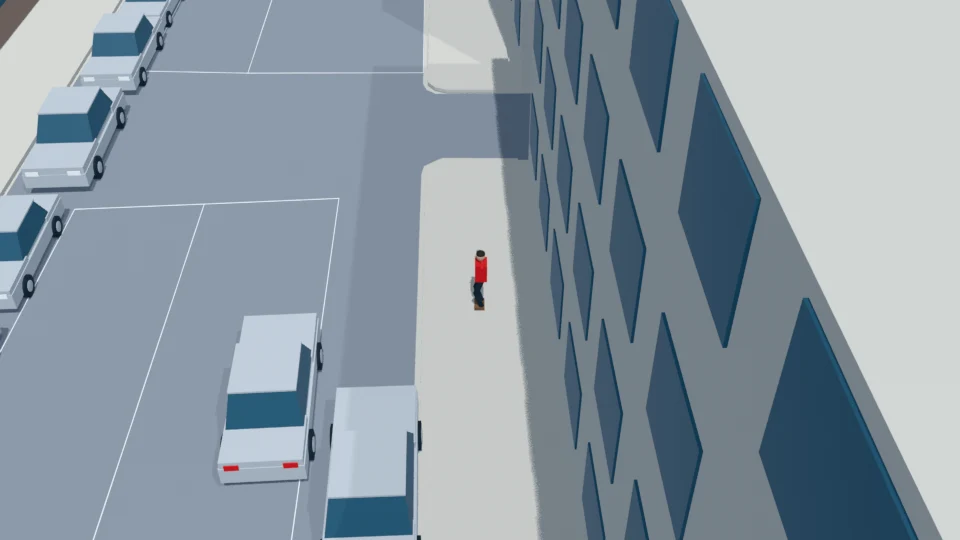
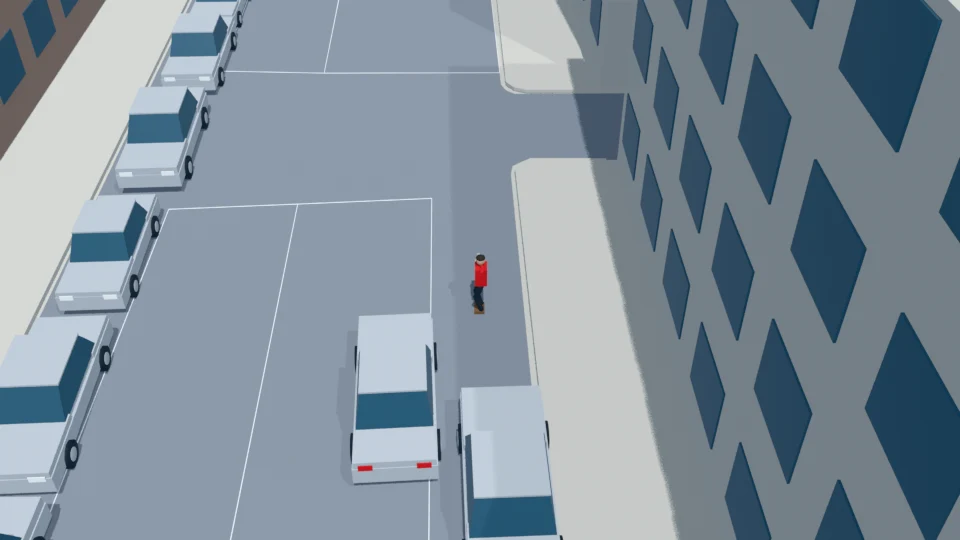
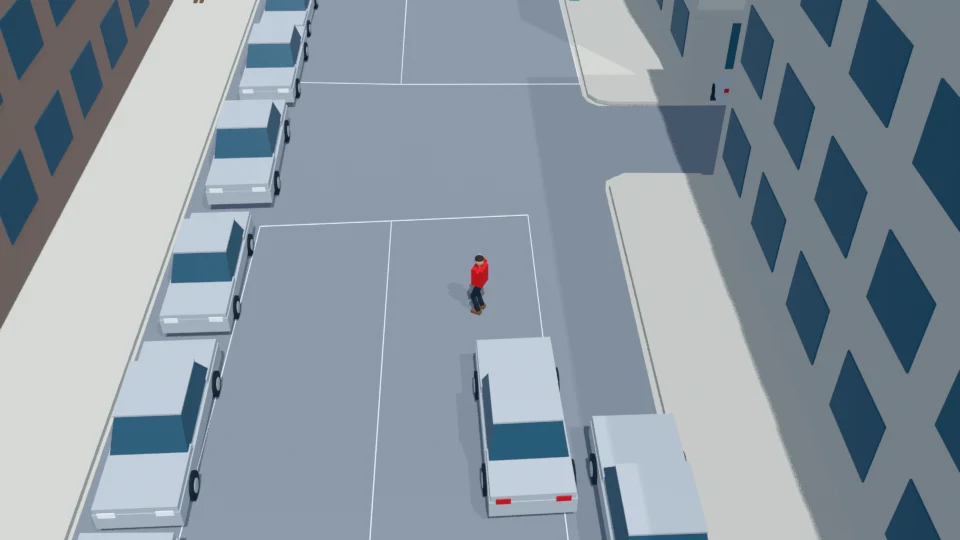
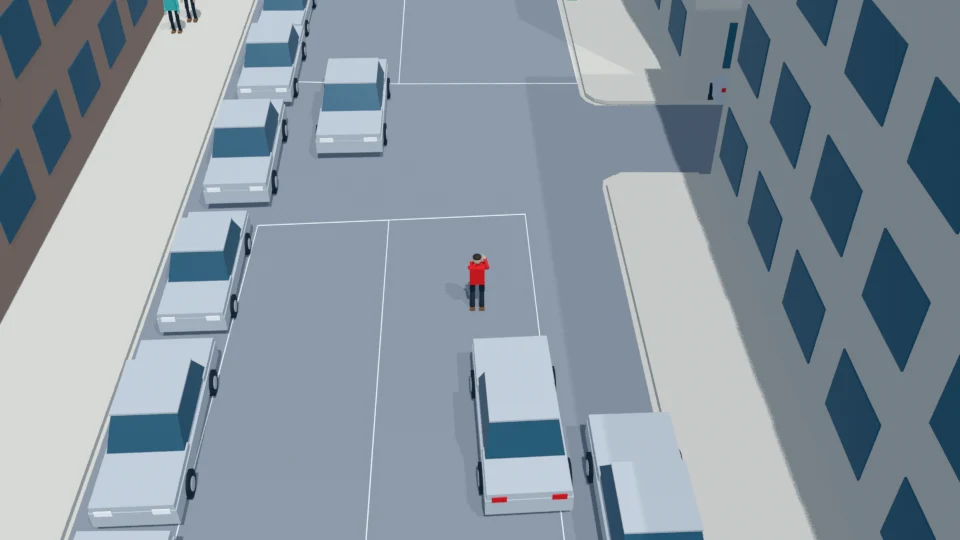
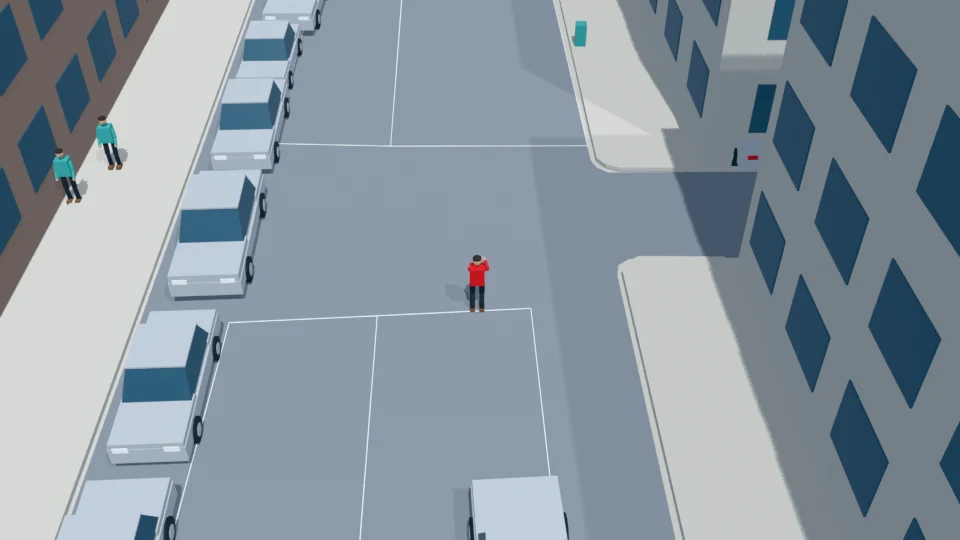
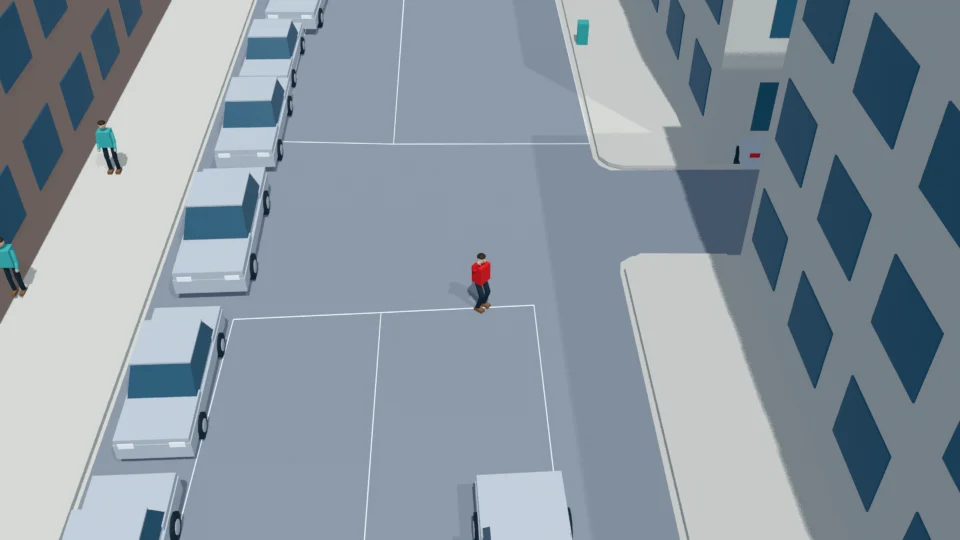
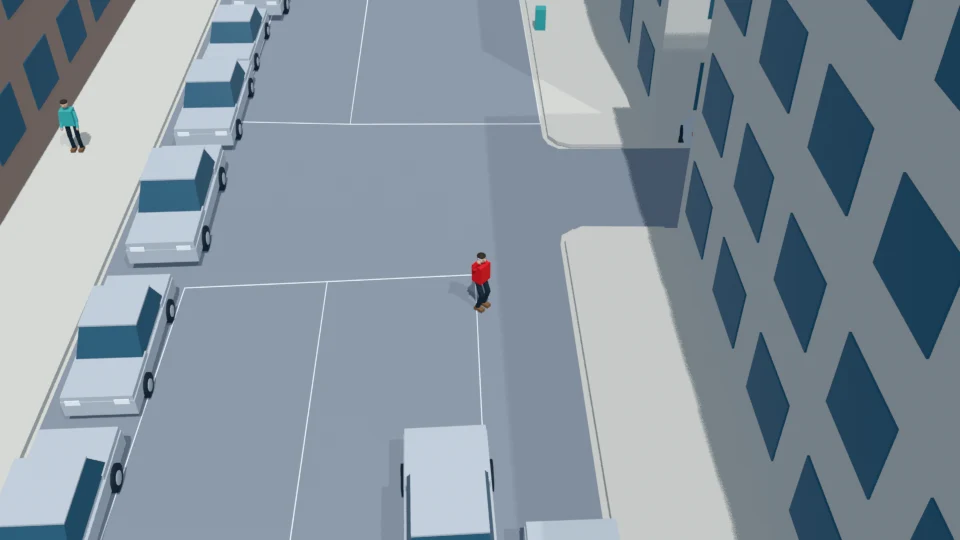
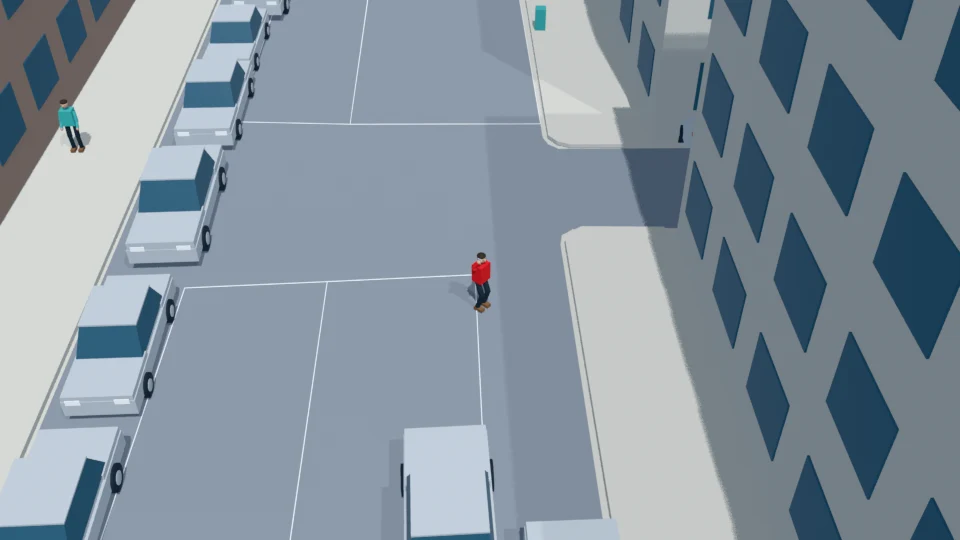
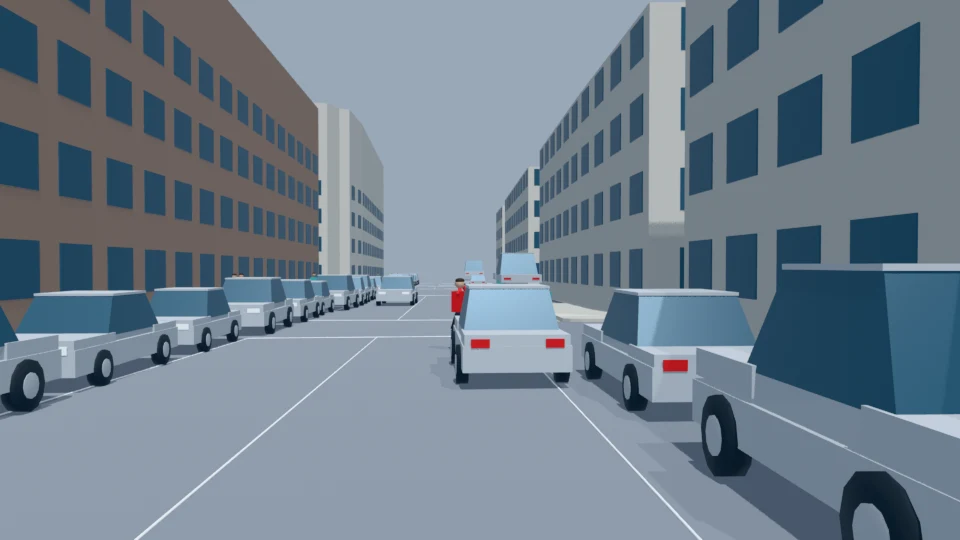
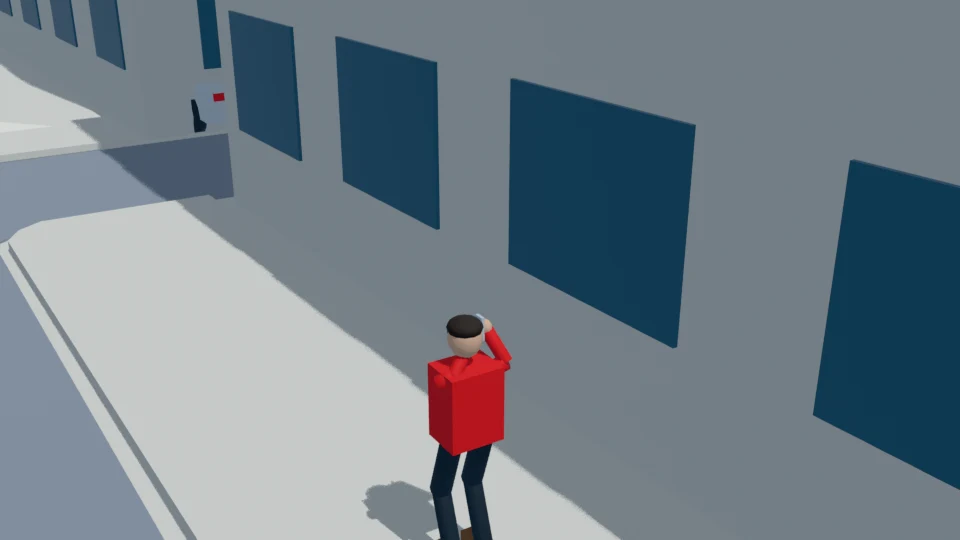
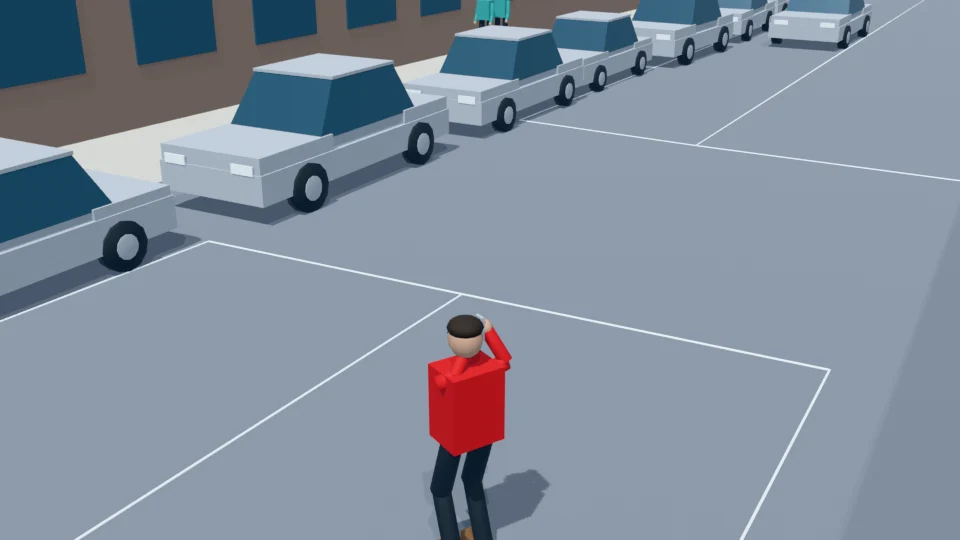
Original NAVSIM camera context
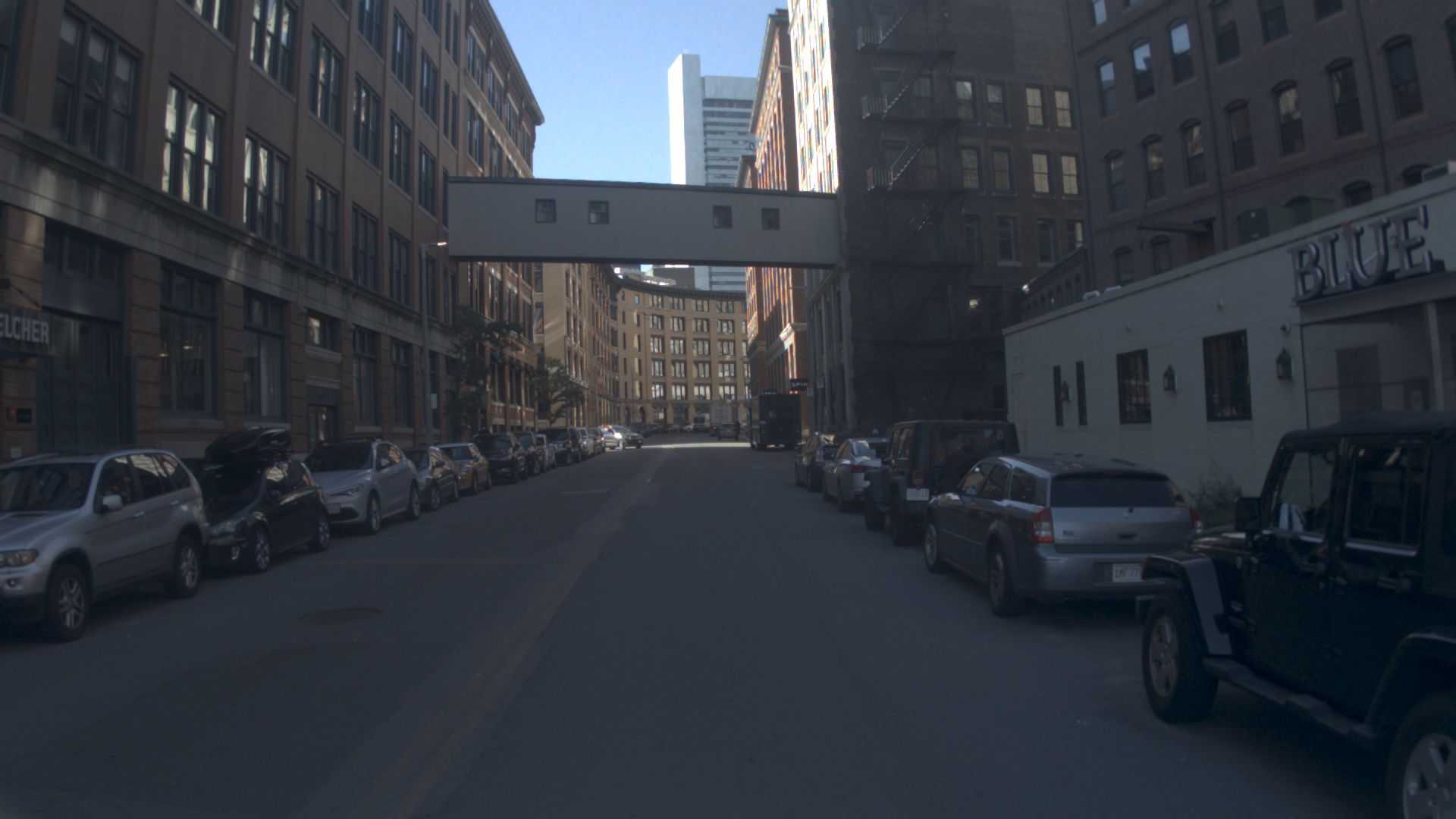
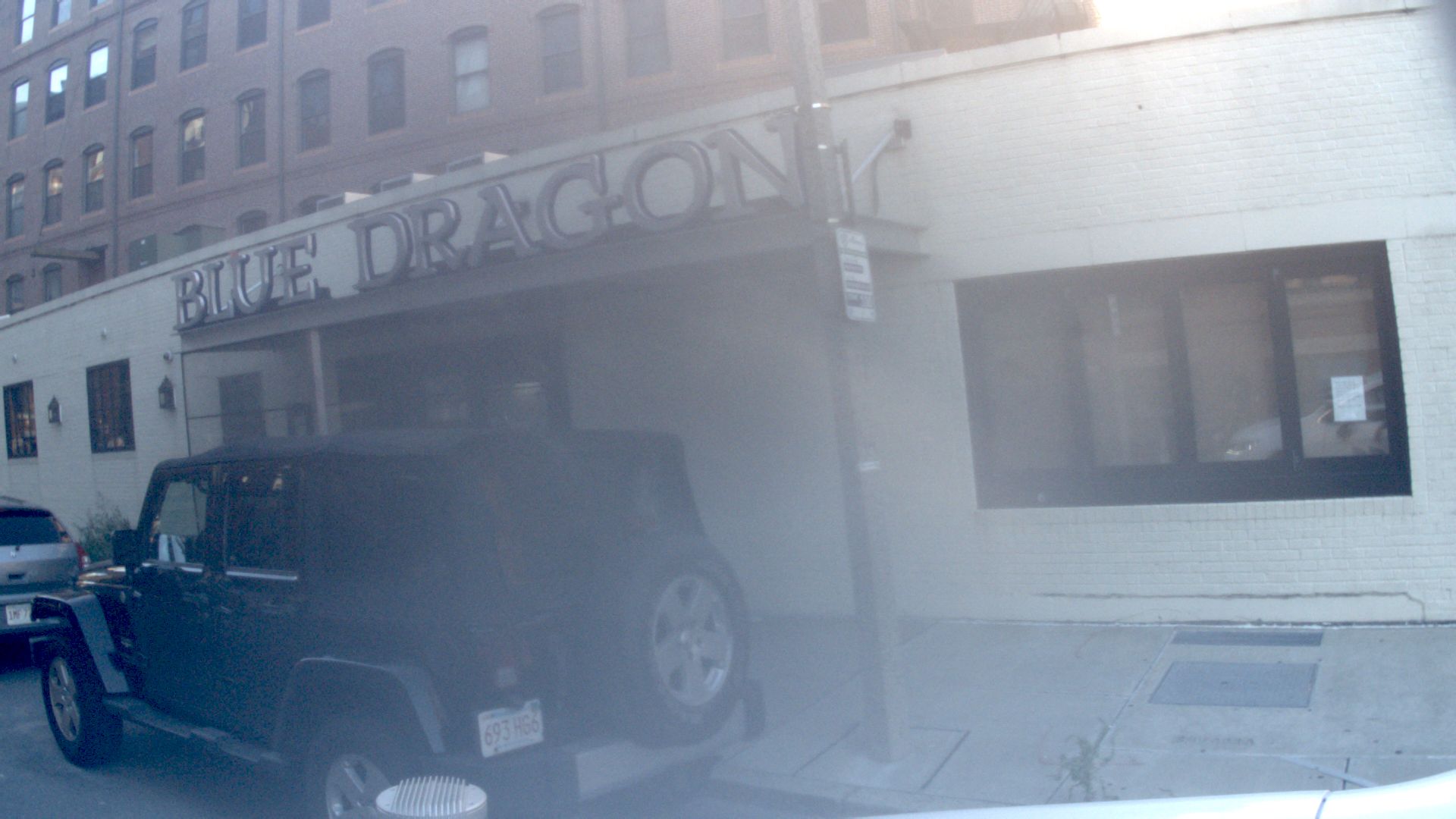
1 conflicting background vehicles were moved to clear holding positions for this counterfactual rehearsal. Original photos remain unchanged. Before later inpainting, any overlap with original-photo traffic must be resolved. Background positions in this 3D rehearsal are not an exact replay of the photographs.
After scene approval
The working pipeline will edit each original NAVSIM camera photograph with Image 2.5. Its same-time Higgsfield view will provide position and posture, annotated with facing direction and current speed. Temporal image requests will cover the full event with a 1 Hz base plus critical moments.
Assumptions and source provenance
- Image #2 supplies buildings, the overhead enclosed bridge, road, sidewalks, and parked-car context. It does not establish a phone argument; the caller, handset, and behavior are counterfactual proposals.
- Playback is finite and non-looping from -7 through 40 s inclusive at 20 Hz, totaling 941 samples. Use bounded C1 root motion, speed-derived walking underneath upper-body gestures, smooth braking, and stationary holds without interpolation overshoot.
- The south sidewalk near x=29 to 36 extends approximately from y=-6.5 to -3.4. The proposal deliberately leaves the caller on the roadway rather than inventing a successful return to that sidewalk.
- The supplied ground plane is interpreted as ground height a*x+b*y+c. Human z remains zero; the attached phone's listed z values are offsets above ground at its own XY, not absolute elevations.
- Ego is separate from this cast: length 4.5 m, width 1.9 m, y=0. It starts at x=4 at -7 s with speed 4 m/s, stops smoothly at x=12 by -3 s, and stays there through 40 s. Its buffered corridor is y=-1.5 to 1.5.
- Raised voice and agitation express the requested scenario, not a diagnosis or an inference from the photograph. No physical confrontation is proposed.
- Precise background occupancy requires human review. Approval is pending; later Image 2.5 must edit original Image #2 and use the rehearsal only for actor position and posture.
Fresh GPT-6 motion plans use semantic descriptions from the pinned consolidated catalog and NAVSIM environments. No upstream nuPlan vectors, trajectories or images are used. The four source environments are reused; 82 scenario descriptions do not mean 82 independent locations.
Higgsfield revision 1. The portable GLB combines export clips without changing geometry or animation samples.
This review uses Higgsfield revision 1 and the exact exported scene snapshot.
Higgsfield workspace (latest revision) · Download animated GLB · GPT-6 scene plan · Visual review evidence · Motion checks · Approval status