MARSAD / CONSOLIDATED CATALOG / #025
Sudden collapse with bystander assistance and ambulance crew
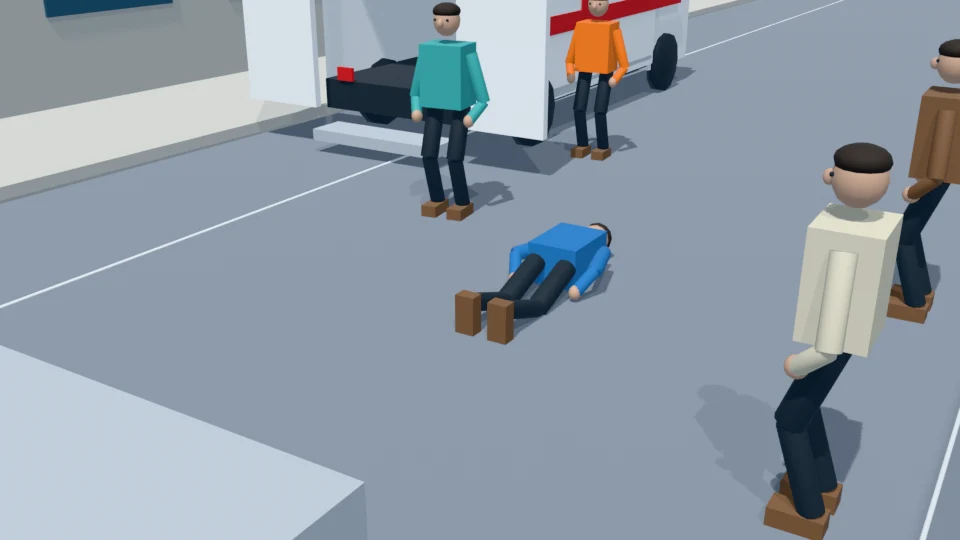
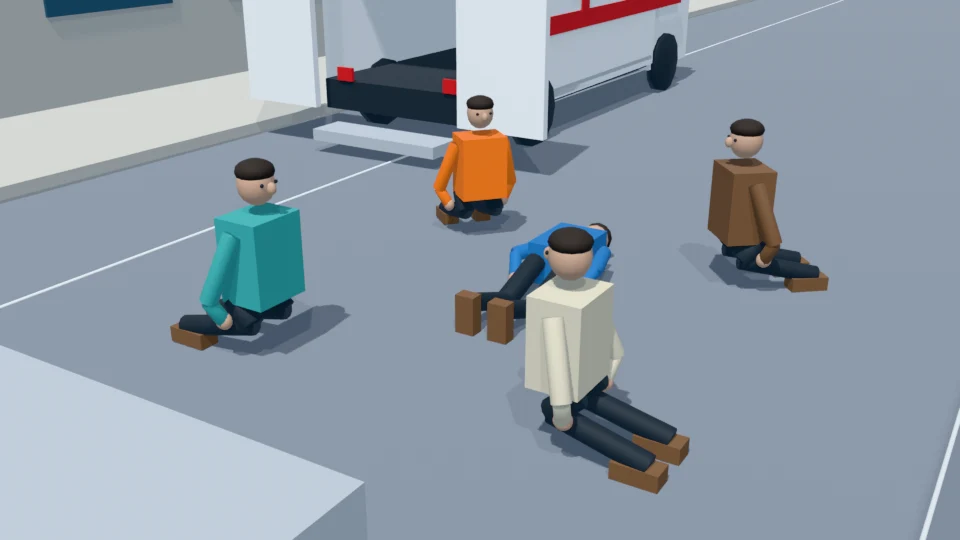
Awaiting your 3D scene approvalCounterfactual: An adult becomes unwell while crossing, lowers toward the surface, and lies non-graphically in the roadway. Two passersby attempt assistance, another warns approaching traffic, and two nearby ambulance crew members join them. Care continues in place through the end.
Original description: 前方有人突发疾病(如癫痫、心脏病),瘫倒在路边或道路上,周围有多个路人正在尝试施救。
Loading the full animated scene…
Critical moments
What to verify
- Exactly seven critical actors persist: one patient, three bystanders, two ambulance crew members, and one ambulance.
- Verify the complete -7..40-second sequence at 20 Hz, including approach, onset, collapse, assistance, continuing care, and final state.
- Verify the patient transitions through stand and crouch before prone, without teleportation, floating, graphic injury, or an asserted diagnosis.
- Both assisting bystanders must arrive by continuous walking paths from the actual south sidewalk; the third must visibly signal approaching traffic.
- Verify both crew paths avoid the ambulance footprint and maintain at least 0.6 m separation from other ordinary walkers.
- Verify all four kneeling caregivers remain outside the patient's posed body footprint; only intentional hand contact is permitted.
- Do not invent recovery, loading, ambulance departure, or corridor clearance. Patient occupancy requires ego_release_s=-1.
- Require human approval of the full rehearsal and time 4 before image generation. Later Image 2.5 must edit original Image #1 rather than a rendered reconstruction.
Review notes
Inspected the full scene and two added close-ups. The patient lies horizontally on the roadway; responders approach and kneel around the patient while the marshal holds traffic. The open ambulance rear remains visible. The added close-ups resolve the foreshortened overhead view.
Check action, relative position, facing, posture and visibility. Approximate offsets are acceptable. Sampled visual checks do not prove every contact or continuous collision clearance.
Rendered inspection views
Event, approach and final views rendered from the exact committed Higgsfield Blender source. These are procedural 3D previews, not generated training photographs.
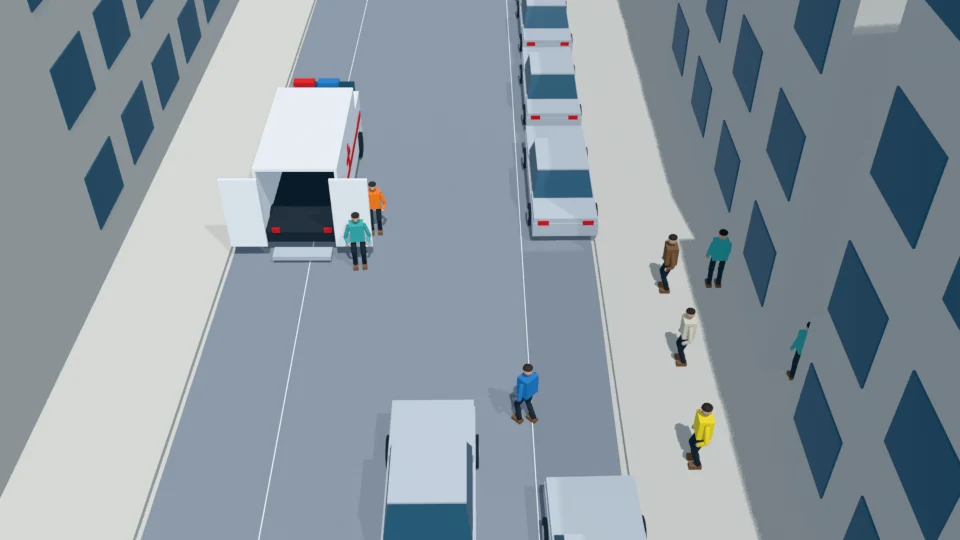
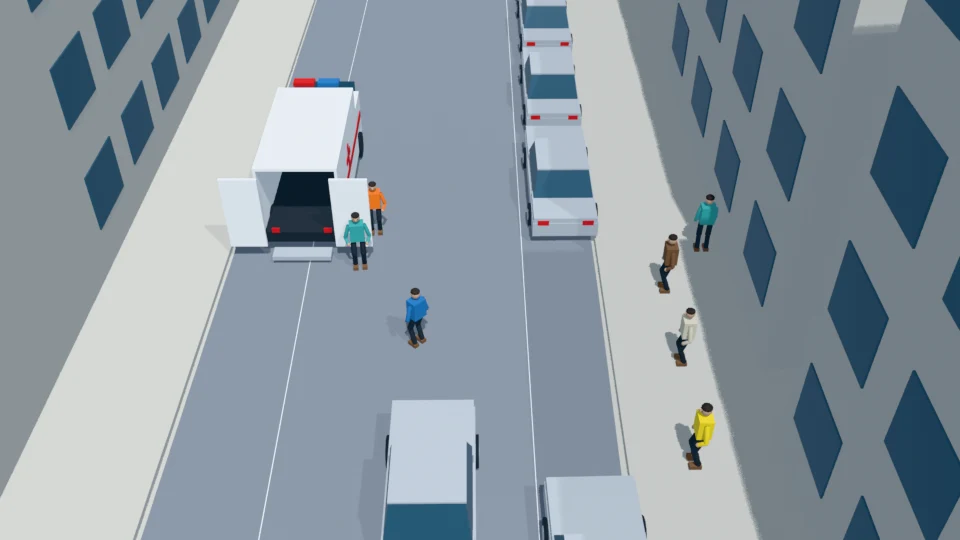
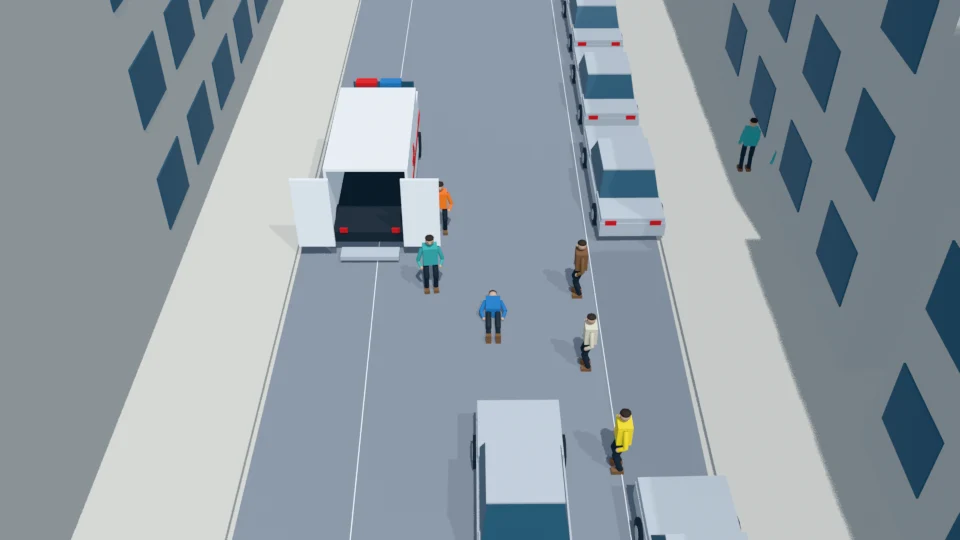
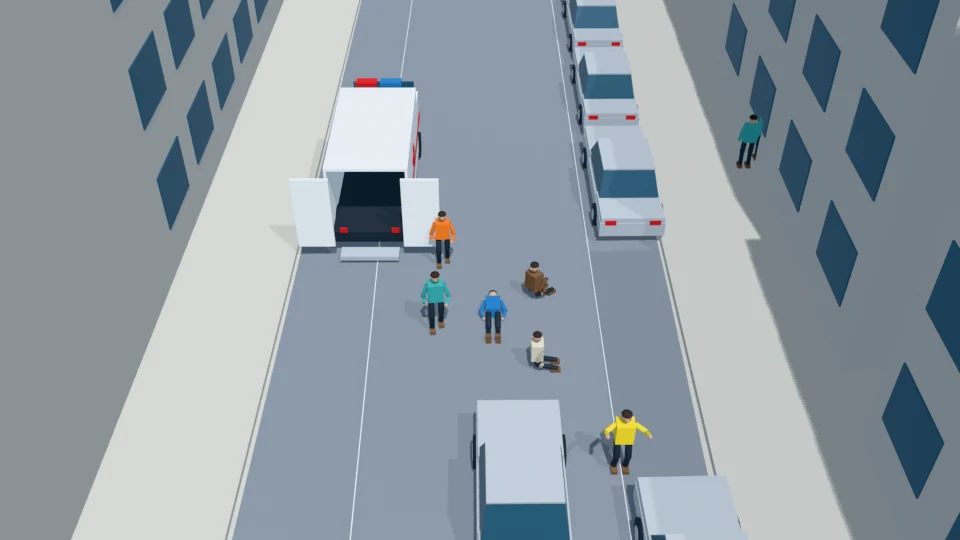
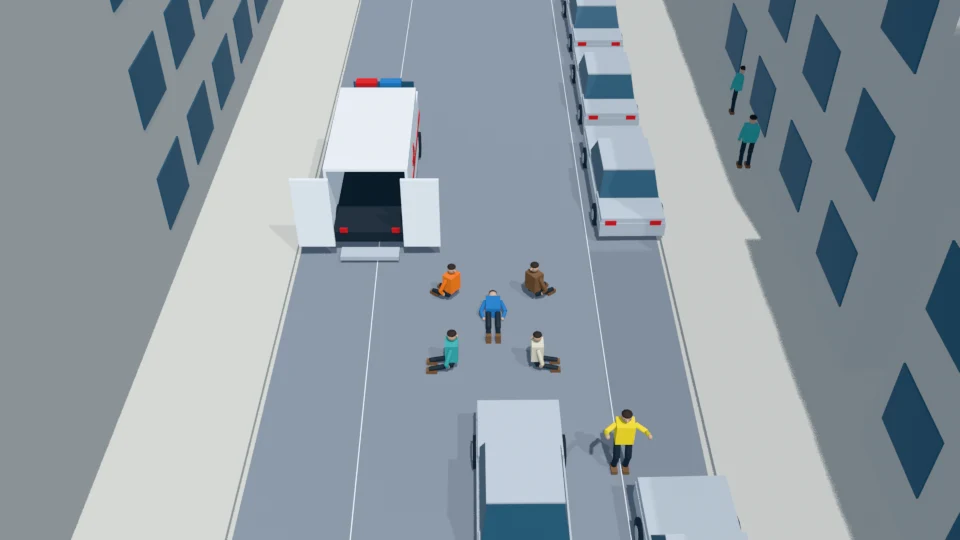
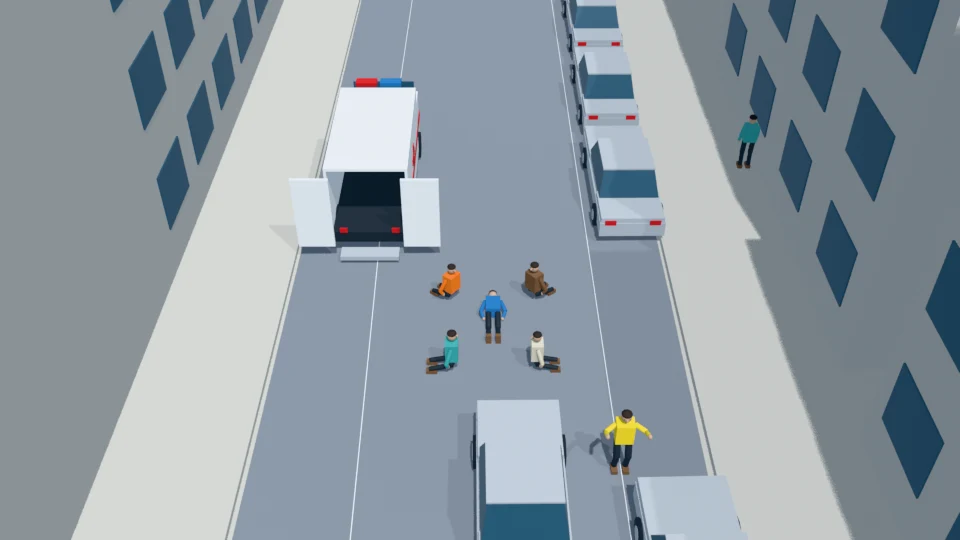
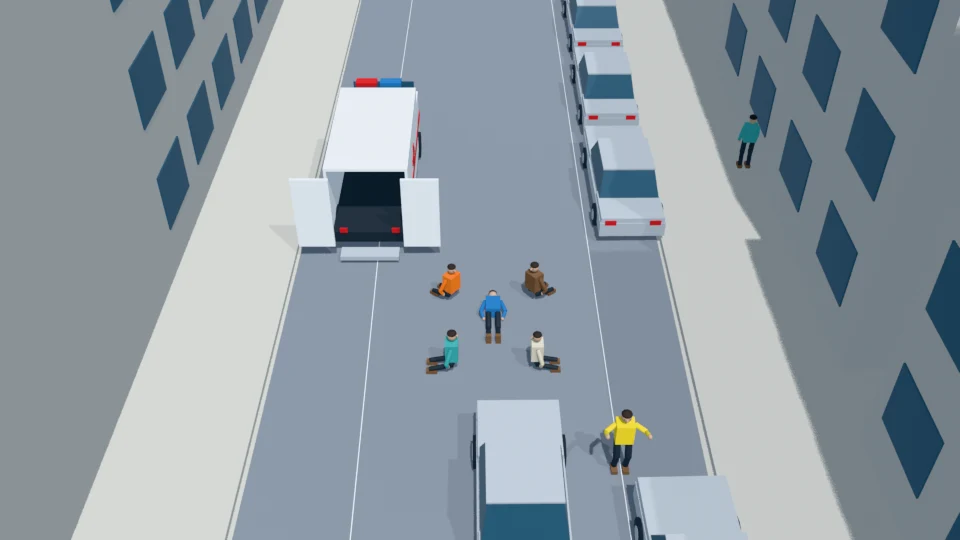
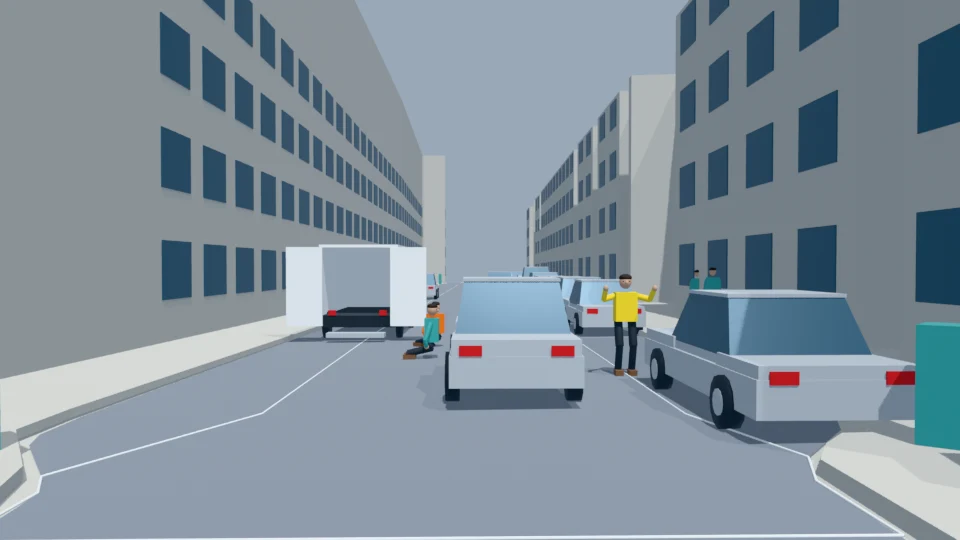
Original NAVSIM camera context
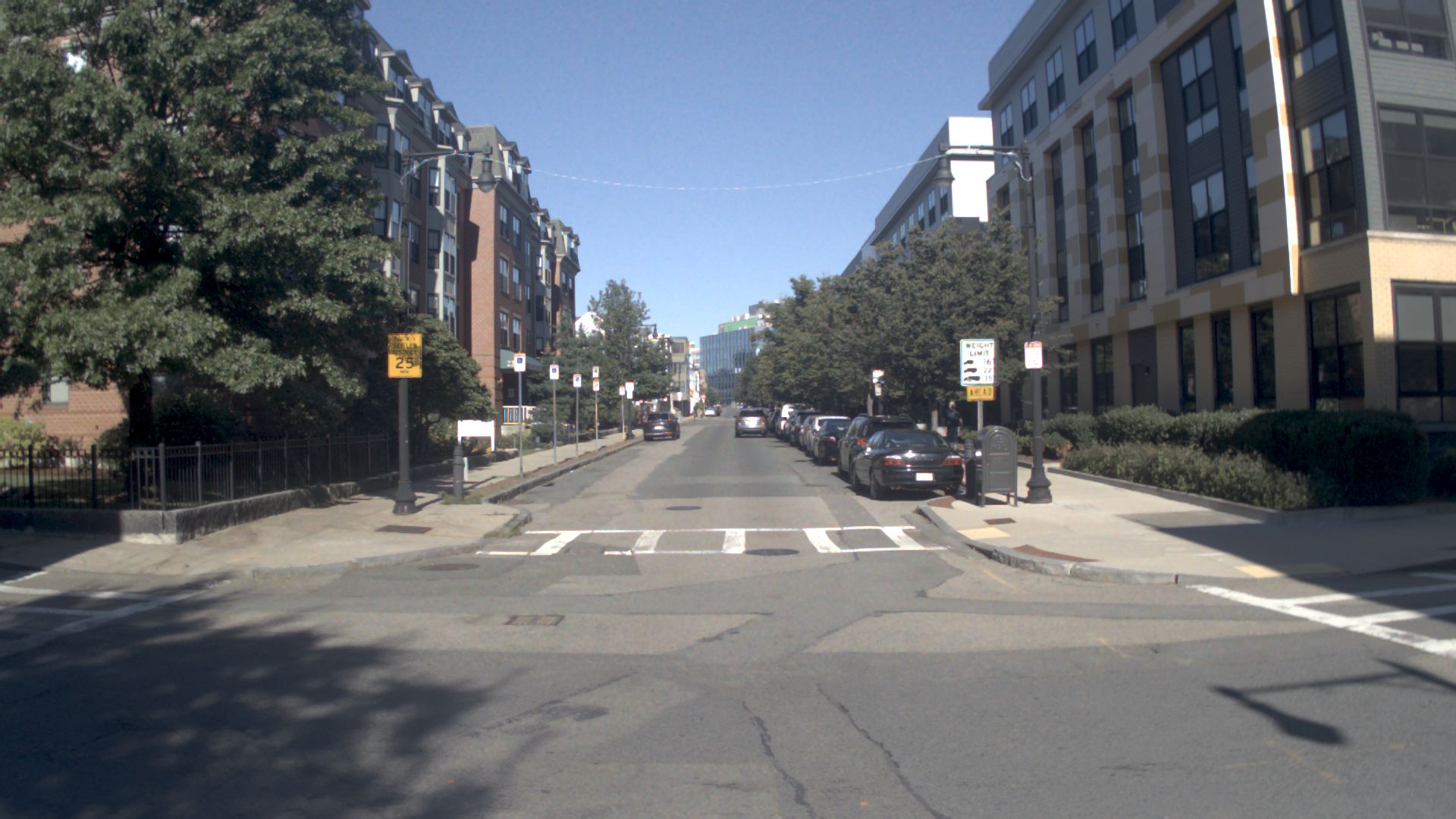
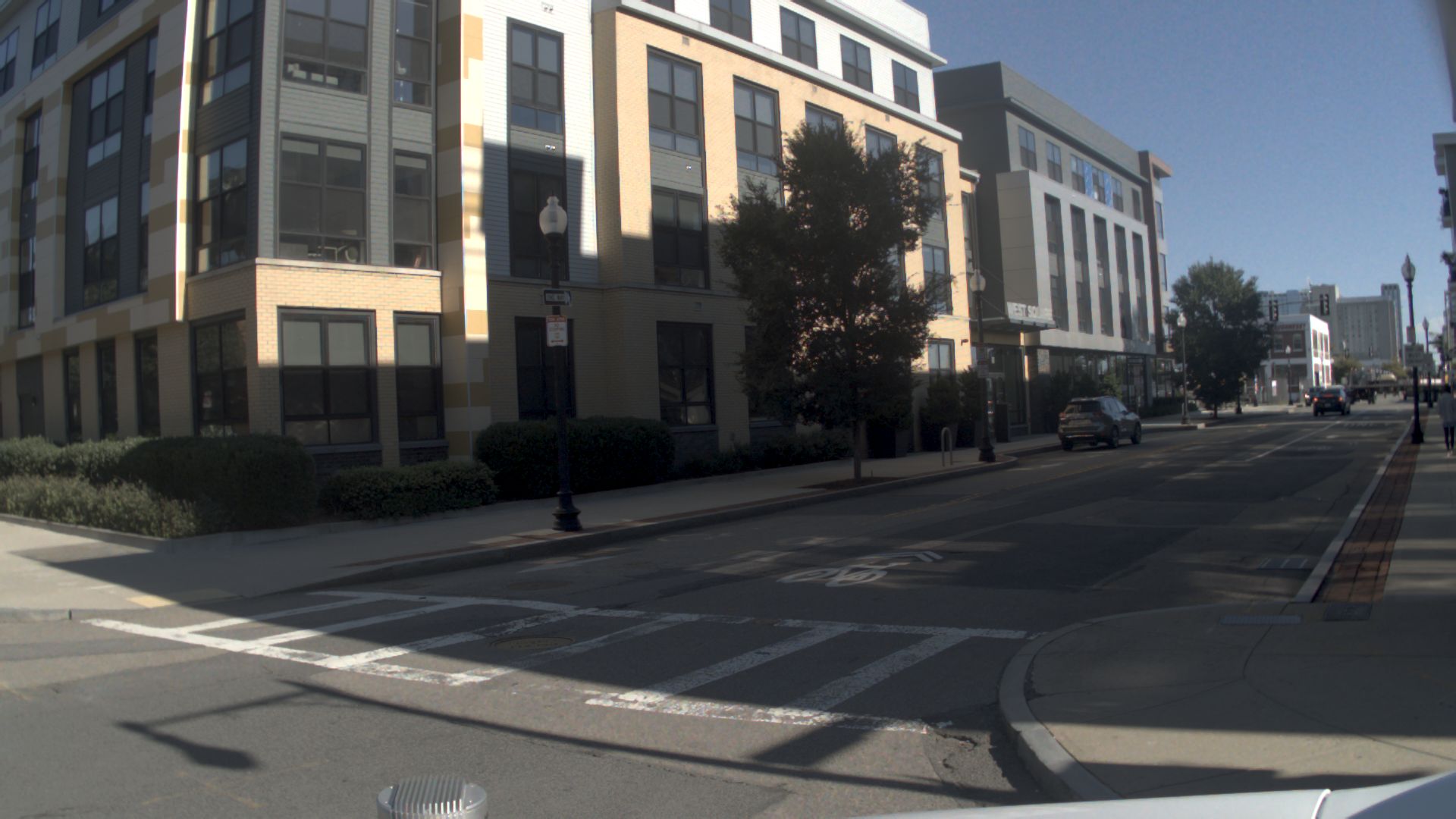
1 conflicting background vehicles were moved to clear holding positions for this counterfactual rehearsal. Original photos remain unchanged. Before later inpainting, any overlap with original-photo traffic must be resolved. Background positions in this 3D rehearsal are not an exact replay of the photographs.
After scene approval
The working pipeline will edit each original NAVSIM camera photograph with Image 2.5. Its same-time Higgsfield view will provide position and posture, annotated with facing direction and current speed. Temporal image requests will cover the full event with a 1 Hz base plus critical moments.
Assumptions and source provenance
- The map and Image #1 establish the street and sidewalk setting, not a medical incident. Every named person, the ambulance, and the entire incident are counterfactual.
- To include ambulance crew without inventing an implausibly short dispatch journey, the ambulance is already parked nearby and both crew members are outside at time -7. Their earlier arrival is outside this excerpt; this is not the separate phone-call-before-arrival variant.
- No particular medical condition can be established from the supplied evidence. The prone pose represents a non-graphic person lying on the surface and is not a treatment recommendation.
- Human dimensions describe standing anthropometry. Pose geometry must extend the patient's 1.76 m stature horizontally when prone and preserve support contact while lowering.
- All approach routes and final positions use the wheelchair road and south sidewalk polygons. The ambulance occupies x=36.6..42.4 and y=2.175..4.325, within the road.
- The built-in ego starts at x=0, y=0 at time -7 with speed 5.6 m/s, brakes smoothly to x=14 at time -2, and remains stopped. Its buffered corridor is |y|<=1.25.
- Use bounded-speed interpolation at 0.05-second intervals, approximately 0.6..1.2 m/s for walking except brief start, stop, and kneeling transitions. All listed z values are mapped-surface support offsets.
- No human approval or image generation has yet occurred.
Fresh GPT-6 motion plans use semantic descriptions from the pinned consolidated catalog and NAVSIM environments. No upstream nuPlan vectors, trajectories or images are used. The four source environments are reused; 82 scenario descriptions do not mean 82 independent locations.
Higgsfield revision 1. The portable GLB combines export clips without changing geometry or animation samples.
This review uses Higgsfield revision 1 and the exact exported scene snapshot.
Higgsfield workspace (latest revision) · Download animated GLB · GPT-6 scene plan · Visual review evidence · Motion checks · Approval status