MARSAD / CONSOLIDATED CATALOG / #027
Hurried food courier weaving through creeping eastbound traffic
Awaiting your 3D scene approvalCounterfactual: A food-delivery scooter travels east much faster than three creeping vehicles. It passes left of a sedan, redirects right around a van blocking that route, and moves left again around a hatchback. After the repeated detours, the courier slows to a shoulder stop, while the remaining queue continues to obstruct ego.
Original description: 前方有外卖配送员为了抢时间,在车流中高速向东穿行,如果遇到被车辆挡住,会频繁绕行。
Loading the full animated scene…
Critical moments
What to verify
- Exactly four non-ego vehicles participate: one rider-inclusive scooter, two cars, and one van. The separately identified food box is the fifth critical actor, not another vehicle.
- Verify the full -7..40-second sequence at 20 Hz, including initial approach, three distinct obstruction-driven detours, braking, the stable queue, and final state.
- Require positive eastward progress throughout scooter motion and continuous steering-compatible headings; do not interpolate lane changes as sideways vehicle translation.
- Use smooth trajectories with scooter speed approximately 4..7 m/s during the fast passes, longitudinal acceleration magnitude no greater than 3 m/s squared, and bounded steering curvature. Allow slower final braking.
- Verify continuous swept vehicle footprints, not just keyframe centers: no collision, gross penetration, curb crossing, or cut-in before clearing a passed vehicle.
- Maintain at least 0.6 m body-to-body clearance during each pass. Include the mounted food box in the scooter's swept envelope.
- Verify all vehicle footprints remain on the police road polygon, including the scooter's final shoulder position near x=99, y=-3.
- Do not release ego merely because the courier has passed. The sedan remains at x=40, y=0 and the hatchback at x=74, y=0 through time 40.
- Require human approval of the full rehearsal and all three detours before image generation. Later Image 2.5 must edit original Image #2, retaining its architecture rather than using the rehearsal as a replacement image.
Review notes
Inspected the delivery-scooter event sequence and parcel close-ups. Rider and oversized parcel remain attached to the scooter across the turn and departure. Parcel obscuration of the rider’s forward view is evident; fine hand and handlebar contacts remain approximate.
Check action, relative position, facing, posture and visibility. Approximate offsets are acceptable. Sampled visual checks do not prove every contact or continuous collision clearance.
Rendered inspection views
Event, approach and final views rendered from the exact committed Higgsfield Blender source. These are procedural 3D previews, not generated training photographs.
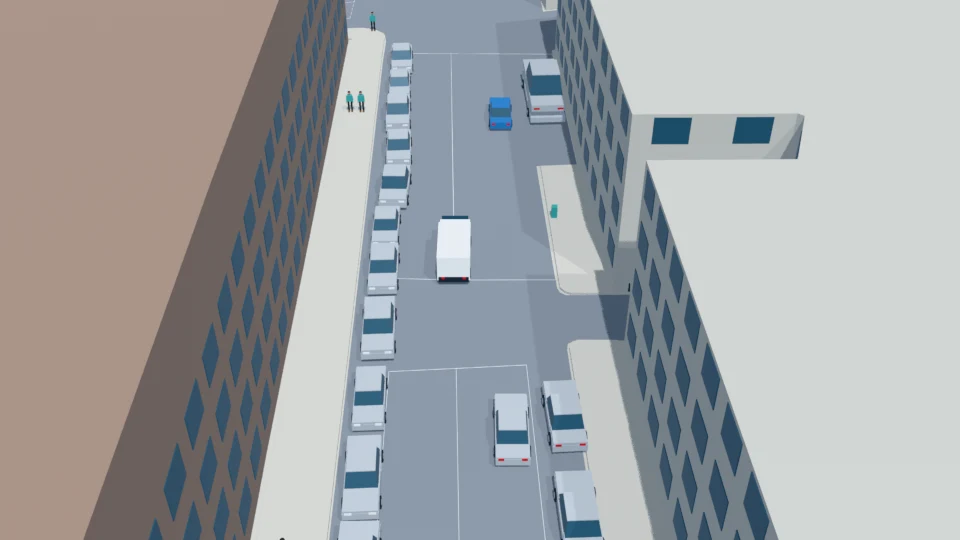
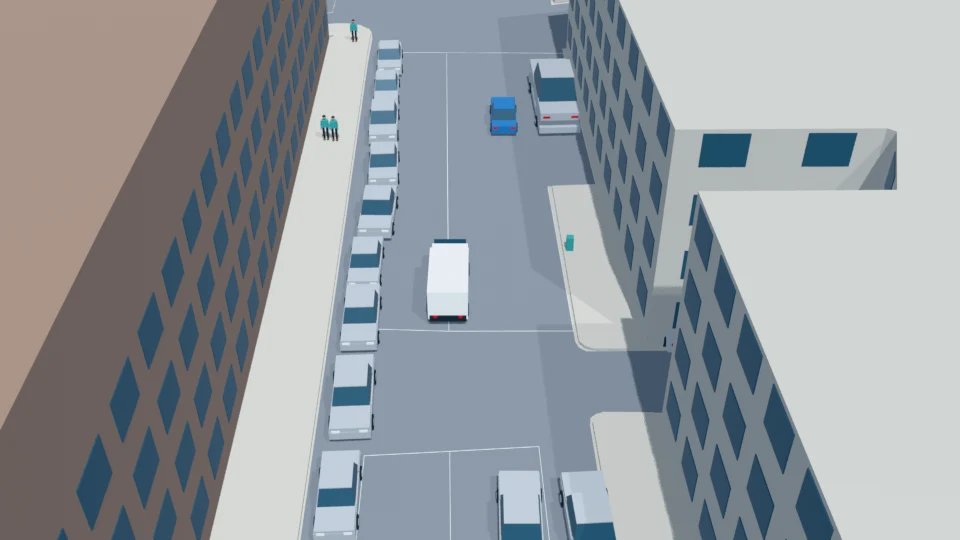
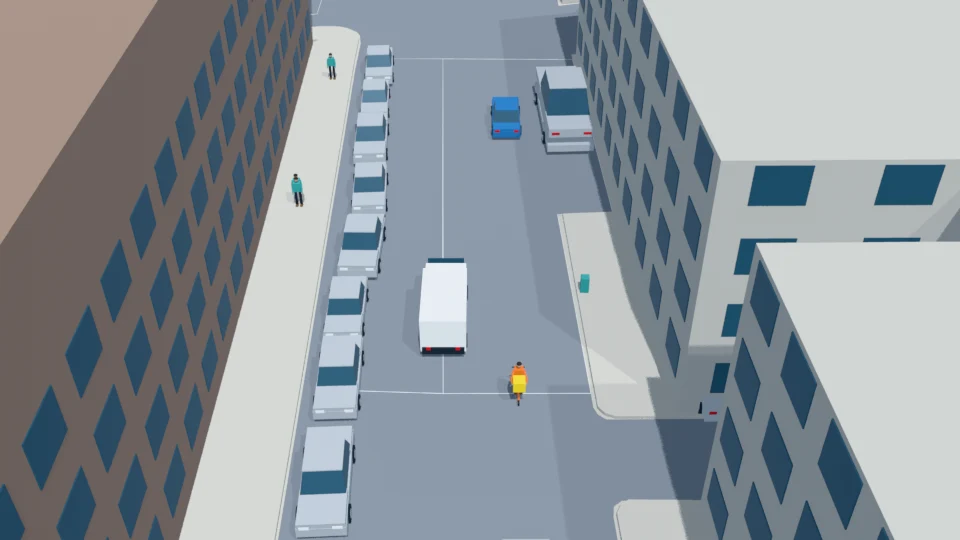
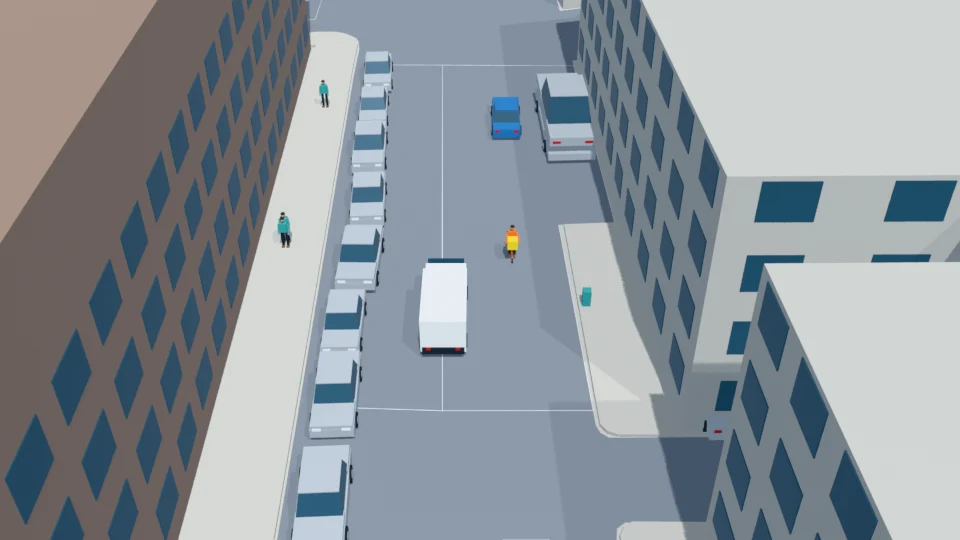
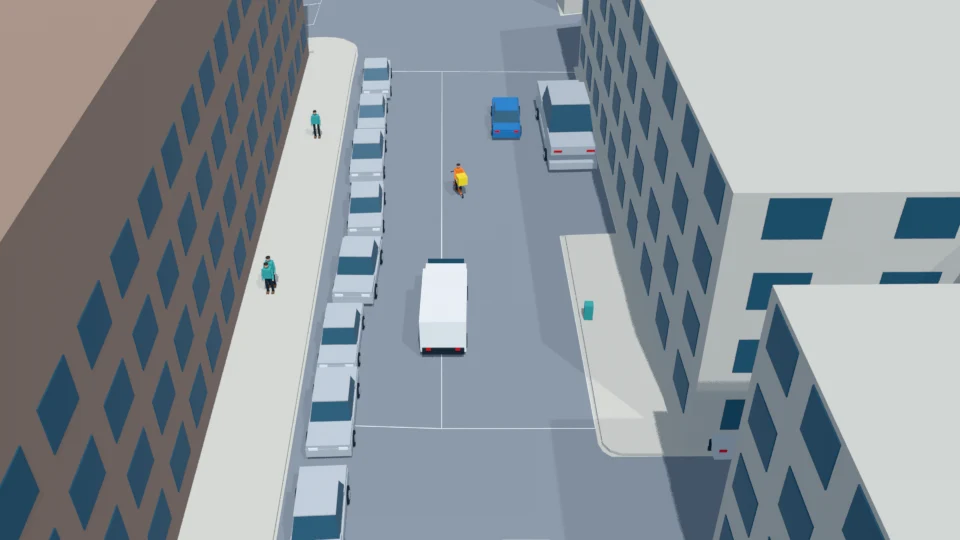
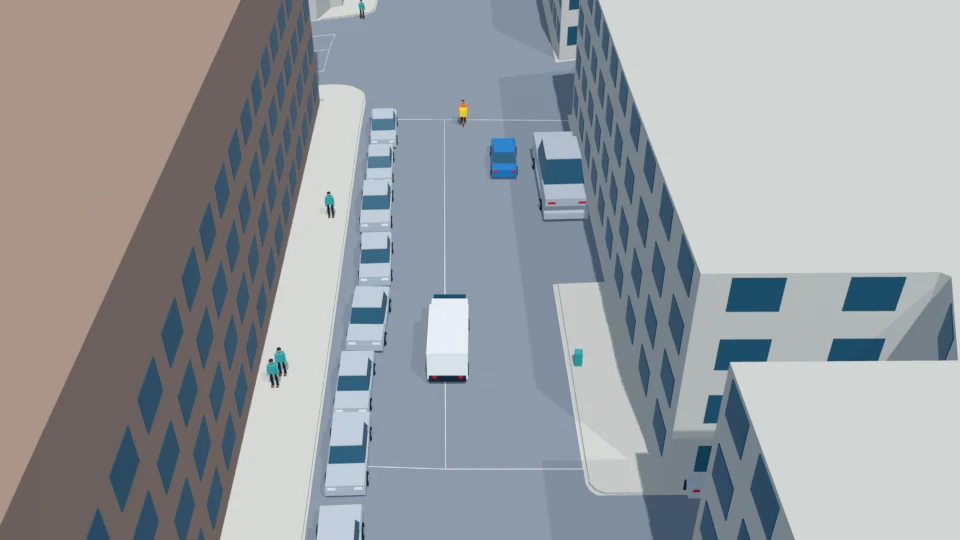
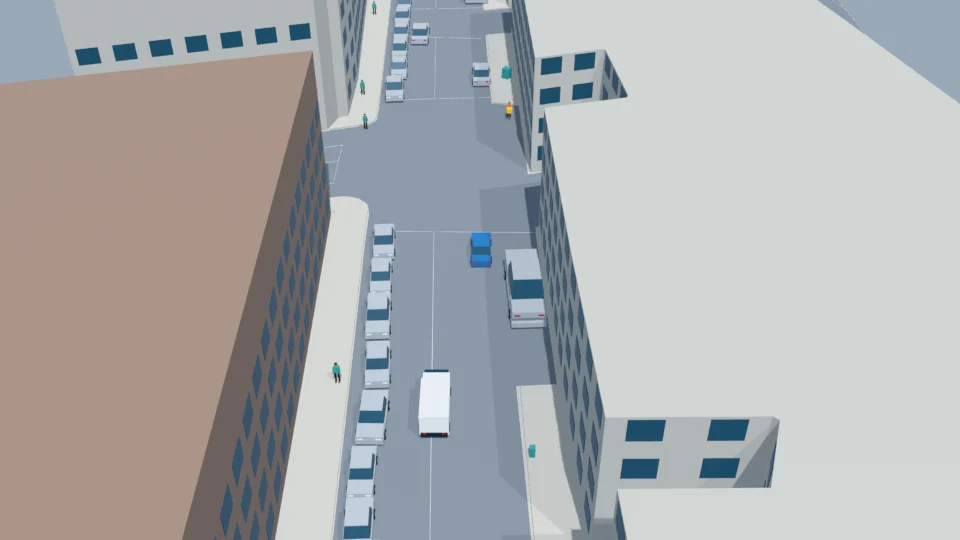
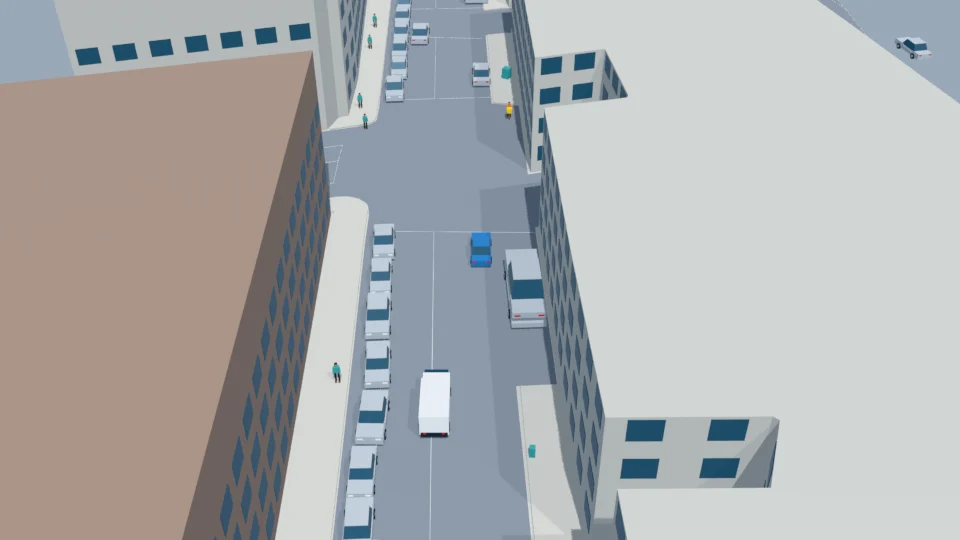
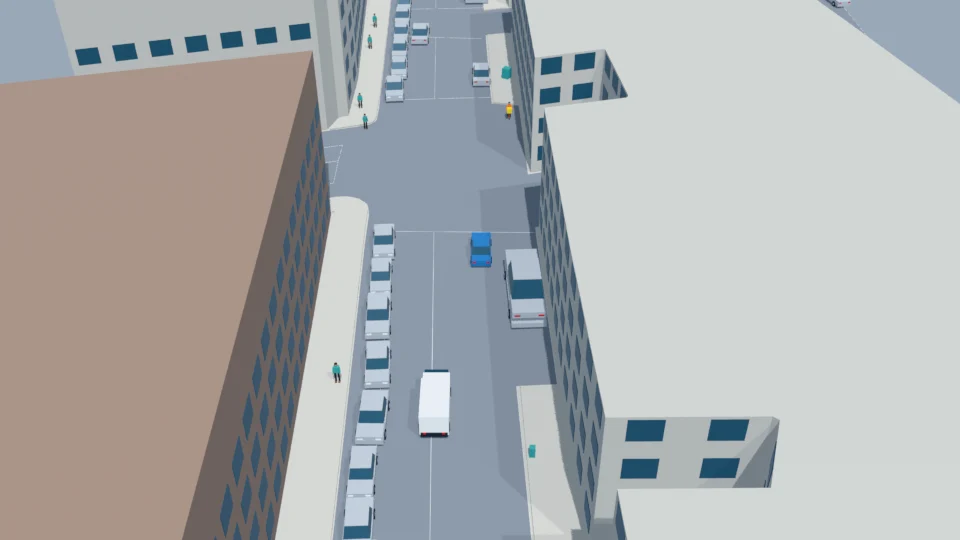
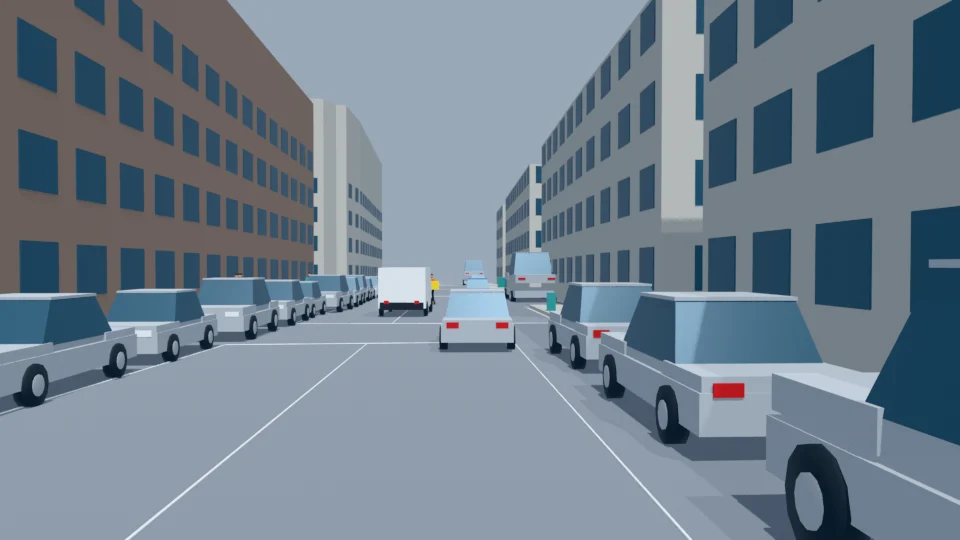
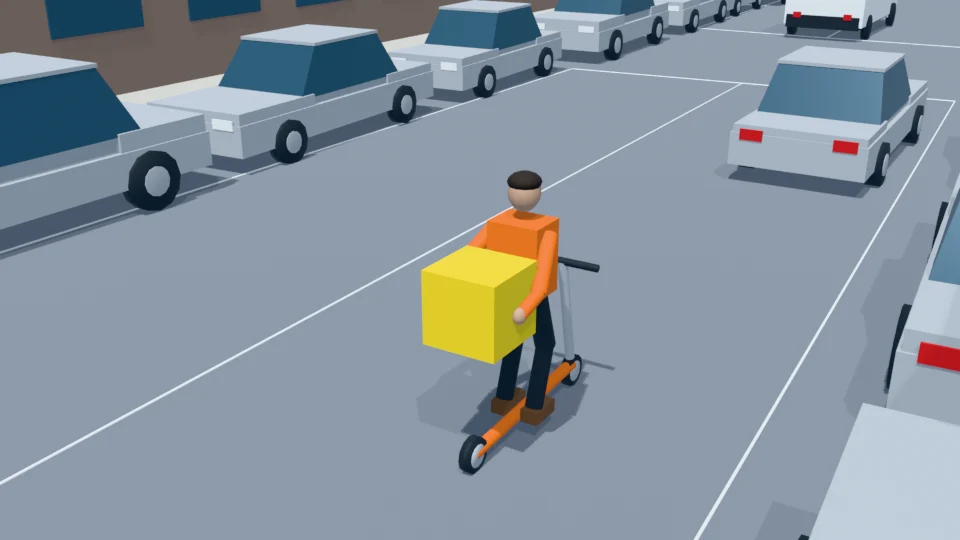
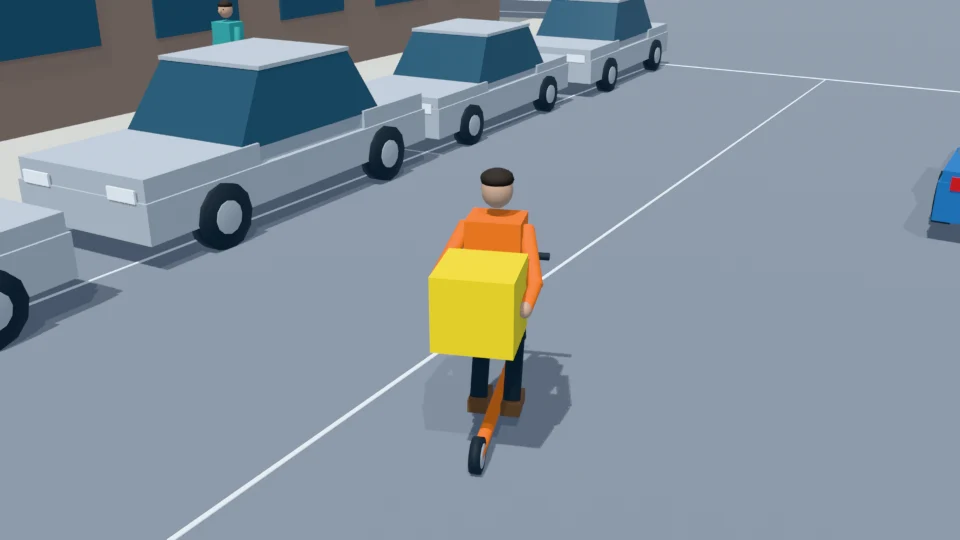
Original NAVSIM camera context
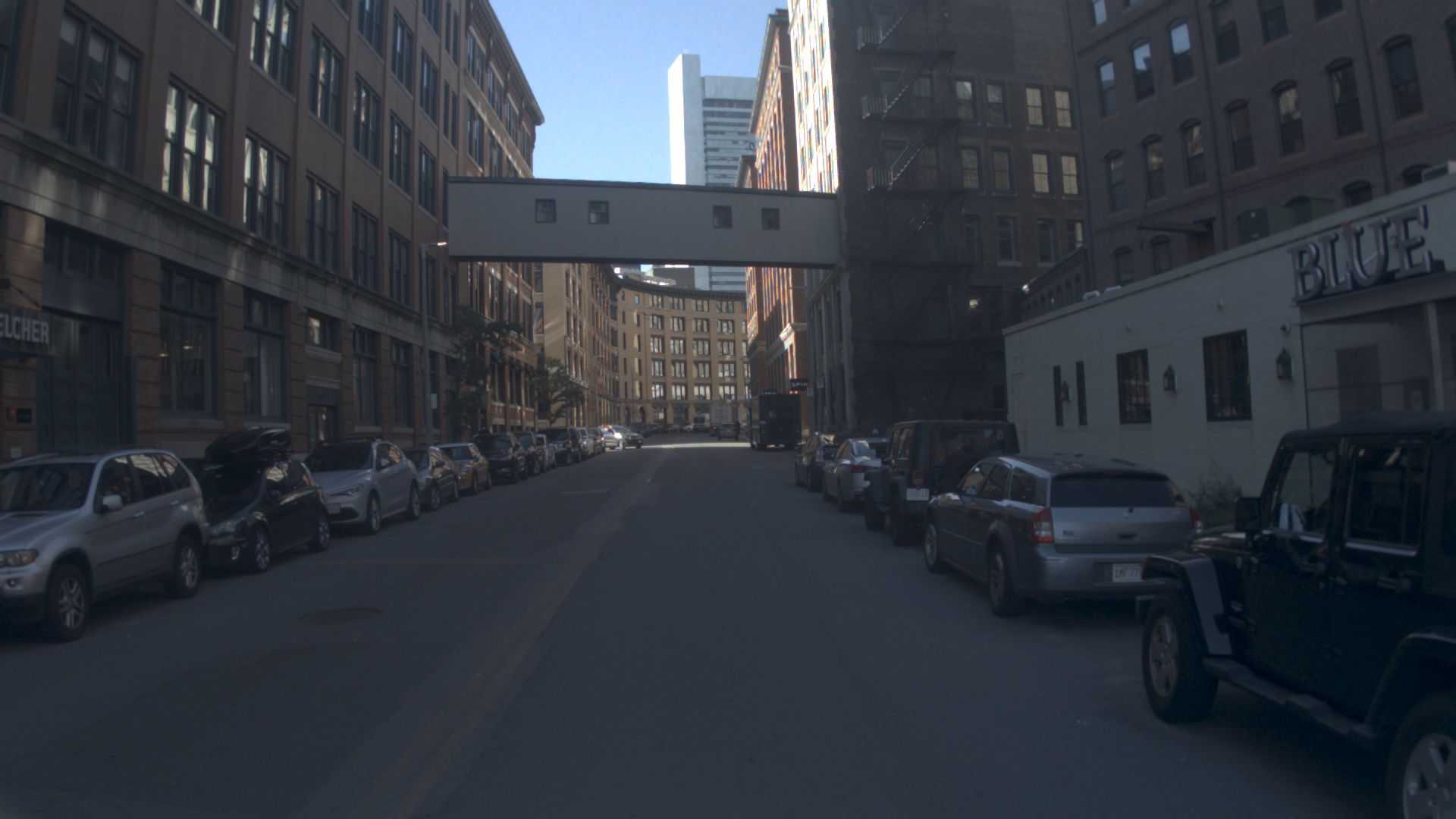
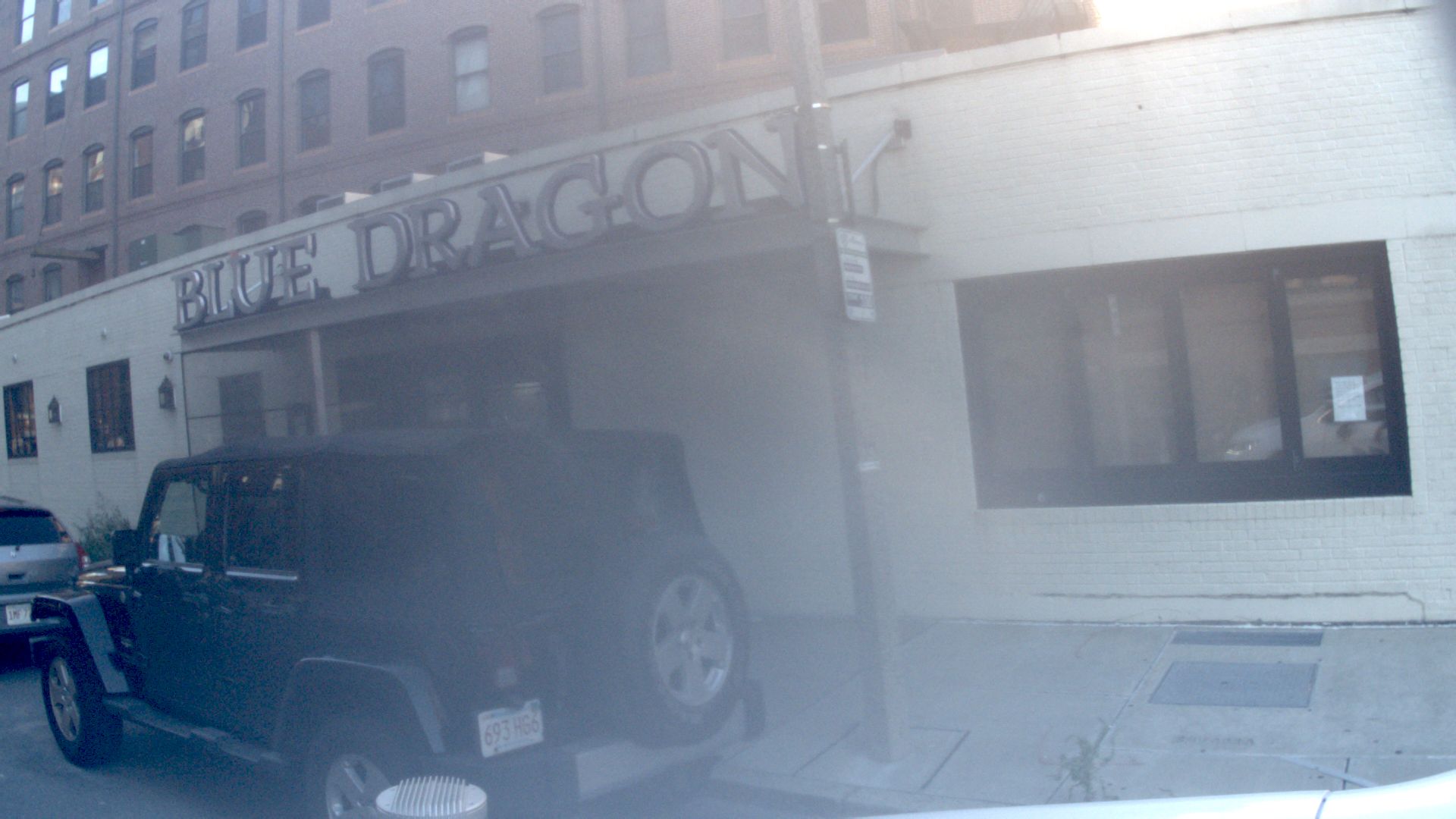
2 conflicting background vehicles were moved to clear holding positions for this counterfactual rehearsal. Original photos remain unchanged. Before later inpainting, any overlap with original-photo traffic must be resolved. Background positions in this 3D rehearsal are not an exact replay of the photographs.
After scene approval
The working pipeline will edit each original NAVSIM camera photograph with Image 2.5. Its same-time Higgsfield view will provide position and posture, annotated with facing direction and current speed. Temporal image requests will cover the full event with a 1 Hz base plus critical moments.
Assumptions and source provenance
- The police template is selected only for its mapped street geometry and Image #2's urban frontage. No police actor, pursuit, traffic violation finding, or observed courier incident is inferred from that source.
- The unspecified traffic is instantiated as exactly four non-ego vehicles: the delivery scooter, a compact sedan, a panel van, and a compact hatchback. Enclosed drivers are implicit vehicle occupants, not additional critical actors.
- The vehicles form a proposed staggered, slowly moving eastbound queue. Their exact lane arrangement and downstream congestion are counterfactual assumptions, not lane-control facts established by the photograph.
- High speed is represented relative to the approximately 0.5 m/s traffic: the scooter reaches approximately 6..7 m/s during its passes. The rider's hurried intent is part of the requested proposal, not an observation.
- The main interaction begins around x=25..50 and extends east to x=99 so the repeated passes and subsequent braking can unfold continuously. All positions remain on the supplied map rather than exiting the scene.
- The courier's final shoulder stop is an authored finite resolution of the weaving, not clearance of the traffic queue. No unlisted vehicle or disappearing obstacle is needed to create that stop.
- Use heading-constrained, bounded-speed interpolation at 0.05-second intervals. Small food-box z differences account for the police ground-plane slope; its permanent attachment controls intermediate motion.
- The built-in ego starts at x=0, y=0 at time -7 with speed 5.6 m/s and brakes to x=14 at time -2. It remains stopped because the buffered corridor |y|<=1.25 stays occupied.
- No human review or image generation has yet occurred.
Fresh GPT-6 motion plans use semantic descriptions from the pinned consolidated catalog and NAVSIM environments. No upstream nuPlan vectors, trajectories or images are used. The four source environments are reused; 82 scenario descriptions do not mean 82 independent locations.
Higgsfield revision 1. The portable GLB combines export clips without changing geometry or animation samples.
This review uses Higgsfield revision 1 and the exact exported scene snapshot.
Higgsfield workspace (latest revision) · Download animated GLB · GPT-6 scene plan · Visual review evidence · Motion checks · Approval status